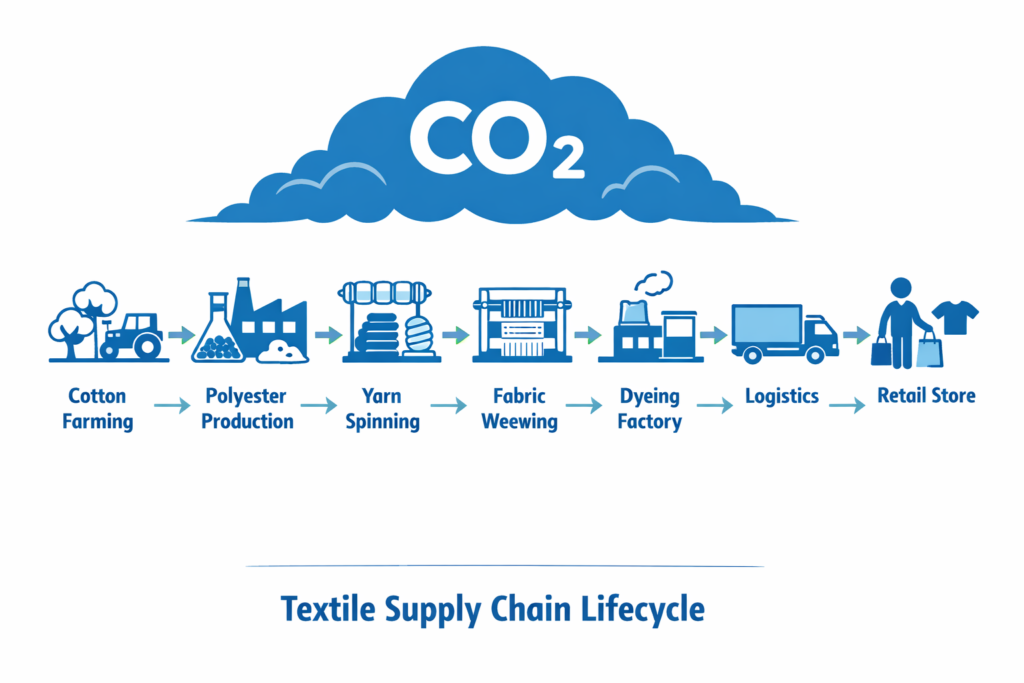
The global textile industry sits at the center of the climate conversation. From cotton cultivation to garment manufacturing, textile value chains stretch across continents and involve hundreds of suppliers, each contributing to the sector’s carbon footprint.
As climate regulations tighten and fashion brands commit to ambitious net-zero targets, measuring greenhouse gas (GHG) emissions has become a strategic necessity rather than a voluntary sustainability effort. Most organizations begin this journey using established frameworks such as the GHG Protocol Corporate Standard or ISO 14064, which provide a structured methodology for calculating emissions across Scope 1, Scope 2, and Scope 3.
However, when these general frameworks are applied to the textile and dyeing industry, a critical reality emerges: standard corporate GHG inventories are not enough to capture the true complexity of textile emissions.
The textile sector requires a far more detailed and process-oriented approach to emissions accounting.
The Limitations of Traditional Corporate GHG Inventories
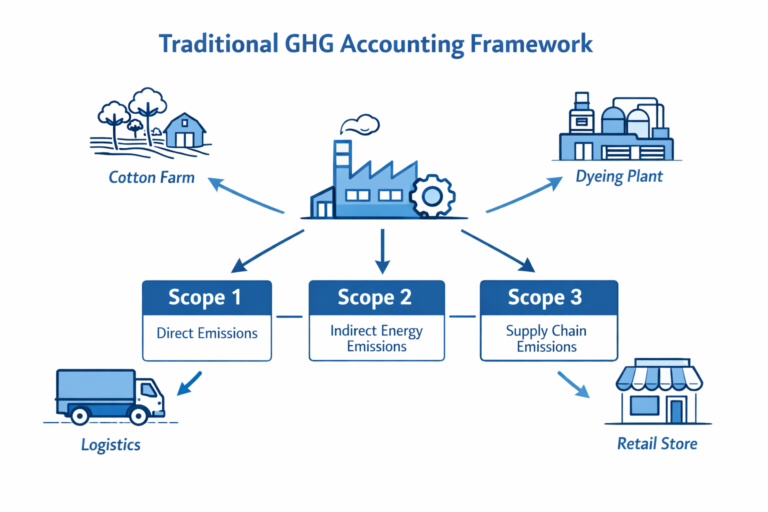
Corporate GHG inventories are designed to work across industries. They typically focus on:
Direct fuel combustion (Scope 1)
Electricity consumption (Scope 2)
Indirect value chain emissions (Scope 3)
For many industries, these categories are sufficient because emissions are concentrated in a few predictable activities such as energy use, transportation, or purchased goods.
But textile manufacturing introduces a different operational reality. Production processes such as spinning, weaving, dyeing, and finishing rely heavily on thermal energy, water-intensive treatments, and chemical processes. As a result, emission sources become far more distributed across factory operations and supply chains.
This is why sector-specific guidance for textile GHG inventories is essential.
What Makes Textile GHG Inventories Different
1. Steam and Heat Dominate the Emissions Profile
Unlike many sectors where electricity is the primary energy source, textile processing relies heavily on thermal energy.
Processes such as dyeing, bleaching, and finishing require large volumes of steam generated through boilers fueled by coal, natural gas, or biomass. These boilers often operate continuously to maintain production temperatures.
As a result, Scope 1 emissions from fuel combustion often represent the largest share of facility emissions, making energy efficiency and fuel switching critical decarbonization opportunities.
2. Industrial Processes Add Hidden Emission Sources
Textile facilities contain multiple emission sources that are not always captured in general corporate inventories.
These may include:
Thermal oil heaters used in finishing operations
Gas-fired singeing machines
Fugitive refrigerant emissions from cooling systems
Emissions from wastewater treatment systems
Each of these sources requires specific data collection and emission calculations, increasing the complexity of inventory development.
3. Wastewater Treatment Becomes a Climate Issue
Textile dyeing and finishing processes generate significant wastewater containing organic matter and chemicals. When this wastewater undergoes biological treatment, it can produce methane and nitrous oxide — two greenhouse gases with high global warming potential.
This means wastewater treatment is not only an environmental compliance issue but also an important component of facility-level carbon accounting.
4. The Supply Chain Often Holds the Largest Carbon Footprint
While facility emissions are important, the most significant difference in textile GHG inventories lies beyond factory walls.
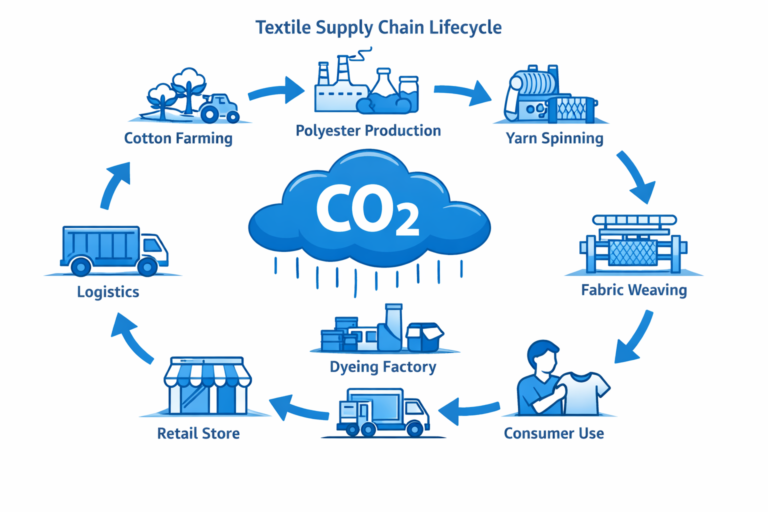
Textile production depends on an extensive network of upstream and downstream partners, including:
Fiber production (cotton, polyester, viscose)
Yarn and fabric manufacturing
Chemical suppliers
Logistics providers
Retail and consumer use phases
When emissions across this value chain are considered, Scope 3 emissions often represent the majority of the sector’s total carbon footprint.
For many apparel brands, supply chain emissions account for more than 80–90% of total emissions.
This fundamentally changes the role of GHG inventories.
Instead of focusing only on internal operations, organizations must now understand emissions across their entire supplier ecosystem.
The Real Challenge: Monitoring Supply Chain Emissions
Tracking emissions across textile supply chains is far more complex than measuring energy consumption within a single facility.
Challenges include:
Limited emissions data from upstream suppliers
Different reporting capabilities across regions
Inconsistent emission factors and methodologies
Lack of standardized data exchange mechanisms
Because textile supply chains can involve multiple tiers of suppliers, companies often rely on generic emission factors rather than primary activity data. While this provides an estimate, it rarely reflects the real emissions associated with production.
The next evolution of GHG inventories therefore lies in building stronger supplier engagement and data-sharing systems.
Moving Toward Data-Driven Supply Chain Transparency
To address these challenges, forward-looking organizations are beginning to rethink how supply chain emissions are monitored.
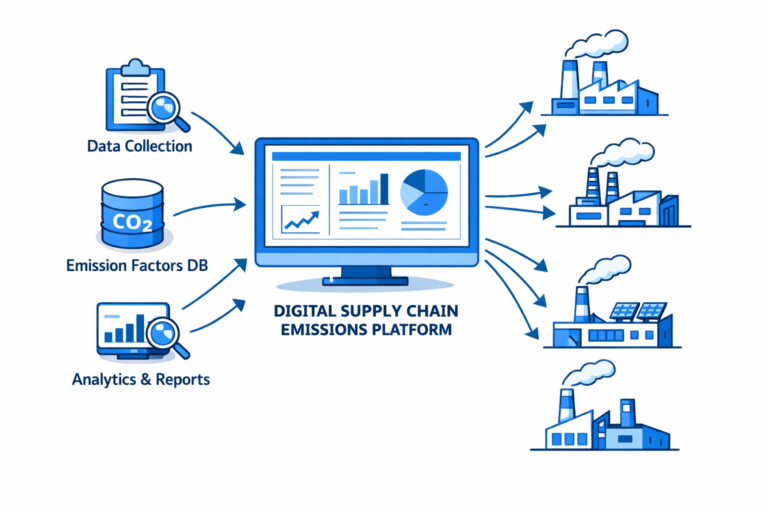
Instead of relying solely on secondary datasets, companies are increasingly focusing on:
Collecting primary activity data from suppliers
Digitizing emissions reporting processes
Creating standardized emission factor repositories
Integrating sustainability data directly into supply chain management systems
This shift transforms GHG inventories from static reports into dynamic decision-support systems that help organizations understand emissions at a much deeper level.
With improved transparency, companies can identify high-impact reduction opportunities such as:
- Low-carbon fiber sourcing
- Energy transition in dyeing facilities
Process optimization in textile finishing
Supplier-level decarbonization initiatives
Why Sector-Specific Inventories Matter for Climate Action
The textile industry faces increasing pressure from regulators, global brands, and consumers to demonstrate measurable climate progress.
However, meaningful decarbonization cannot occur without accurate and sector-relevant emissions measurement.
By adapting general GHG accounting frameworks to reflect the realities of textile production — including steam-based processes, wastewater emissions, and complex supply chains — companies can develop inventories that truly reflect their climate impact.
More importantly, these inventories enable organizations to move beyond compliance and toward strategic carbon management across entire value chains.
Final Thoughts
The transition to net-zero in the textile industry will not be achieved through isolated corporate actions. It requires coordinated efforts across suppliers, manufacturers, brands, and logistics networks.
GHG inventories are the starting point of this transformation. But for textile companies, the real opportunity lies in expanding these inventories beyond factory boundaries and using them to build transparent, data-driven, and collaborative supply chains.
Only then can the industry move from carbon accounting to meaningful climate action.
Source: This article draws insights from the Guidebook on GHG Inventories for the Textile & Dyeing Sector, developed to support textile manufacturers in understanding, calculating, and managing greenhouse gas emissions in line with emerging climate regulations. The guidebook was developed under the Climate Solutions Partnership, funded by HSBC and implemented by World Wide Fund for Nature Vietnam and the World Resources Institute through the Clean Energy Investment Accelerator (CEIA). The methodology builds upon internationally recognized frameworks such as the GHG Protocol and International Organization for Standardization greenhouse gas standards, along with technical guidance from industry initiatives supporting sustainable transformation in the textile and garment sector.
Available at: https://wwfasia.awsassets.panda.org/downloads/textile-handbook-eng_fn–3-.pdf