Abstract
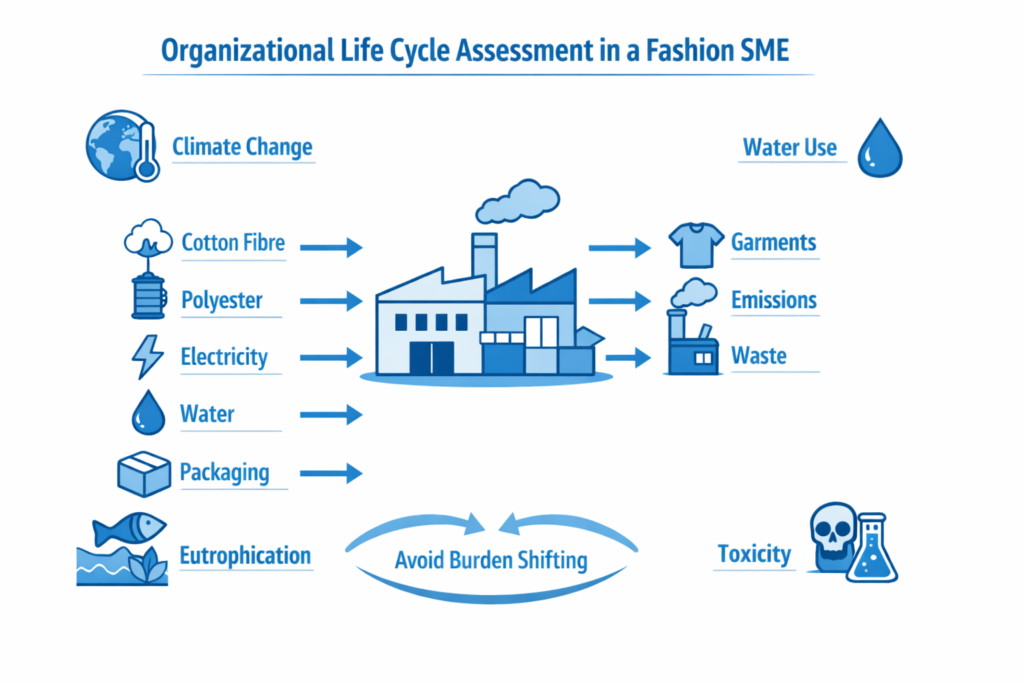
Organisations across industries are under growing pressure to reduce their environmental footprints. However, identifying true environmental “hotspots” is far from simple. Many sustainability initiatives risk shifting impacts from one stage of the value chain to another — reducing carbon emissions, for example, while increasing water use or toxicity elsewhere. This is where Organizational Life Cycle Assessment (O-LCA) becomes a powerful decision-making framework.
This case study applies the principles of ISO 14040 and ISO 14044, along with organizational guidance from ISO/TS 14072, to evaluate the full 2023 operational output of a fashion industry SME. Unlike product-level LCAs, this assessment takes a whole-organisation perspective, mapping all gate-to-gate material and energy flows associated with the firm’s annual production.
Methodological Approach
The study followed a structured O-LCA framework:
Data Collection: Primary inputs and emissions compiled directly on-site
System Boundary: Gate-to-gate flows covering total 2023 production
Modelling Software: SimaPro (version 9.1.1)
Database Used: Ecoinvent – allocation, cut-off system model
Impact Assessment Method: ReCiPe 2016 Midpoint (H)
Impact Categories Analysed: 18 environmental impact categories
This comprehensive approach ensured that multiple environmental dimensions — not just climate change — were evaluated.
Key Findings: Where Are the Real Environmental Hotspots?
The results reveal several critical insights for fashion SMEs:
1. Electricity Consumption – The Primary Climate Driver
Contributes 43.5% to total climate change impacts
Represents the most significant carbon hotspot in operations
Practical Example:
A small fashion manufacturer using grid electricity for cutting, stitching, ironing, and packaging may unknowingly generate nearly half of its climate footprint from energy use alone.
2. Cotton Fibre – A Major Water & Eutrophication Contributor
87.3% of freshwater eutrophication impact
37.8% of total water consumption
Cotton cultivation is resource-intensive, especially in regions with irrigation dependency and fertilizer use.
Real-World Context:
For an Italian SME sourcing conventional cotton fabric, upstream agricultural practices (fertilizer runoff, irrigation systems) heavily influence overall environmental performance — even though those processes occur outside the factory walls.
3. Potential Reduction Strategy
Combined interventions could reduce the organisation’s total climate footprint by up to 34.6%, including:
Transitioning to renewable electricity (e.g., rooftop solar systems)
Increasing recycled fibre content (recycled polyester, recycled cotton blends)
Strategic Recommendations from the Case
The analysis highlights actionable improvement pathways:
Transition to renewable electricity sources (e.g., solar installations)
Source cotton from water-efficient or certified green suppliers
Increase recycled polyester and alternative fibres
Explore material substitution for brass components where feasible
These recommendations are particularly relevant for SMEs, as they balance environmental gains with operational feasibility.
Why This Study Matters Beyond One Company
Although conducted within a single fashion SME context, the methodology and insights are highly transferable. Many small and medium enterprises in Italy and across Europe face similar:
Limited sustainability reporting capacity
Heavy upstream supply chain impacts
Energy-intensive manufacturing processes
By adopting Life Cycle–based methodologies like O-LCA, peer companies can:
Identify true hotspots
Avoid burden shifting
Make data-driven sustainability investments
Align with evolving EU sustainability reporting expectations
Broader Insight for the Fashion Industry
This case demonstrates that environmental responsibility in fashion is not only about switching materials or reducing packaging. It requires a system-level understanding of organisational flows, integrating energy, raw materials, suppliers, and operational decisions into one coherent environmental performance model.
In the following sections of this blog, we will explore how this O-LCA was structured, what challenges emerged during implementation, and what fashion SMEs can practically learn from this approach.
1. Introduction
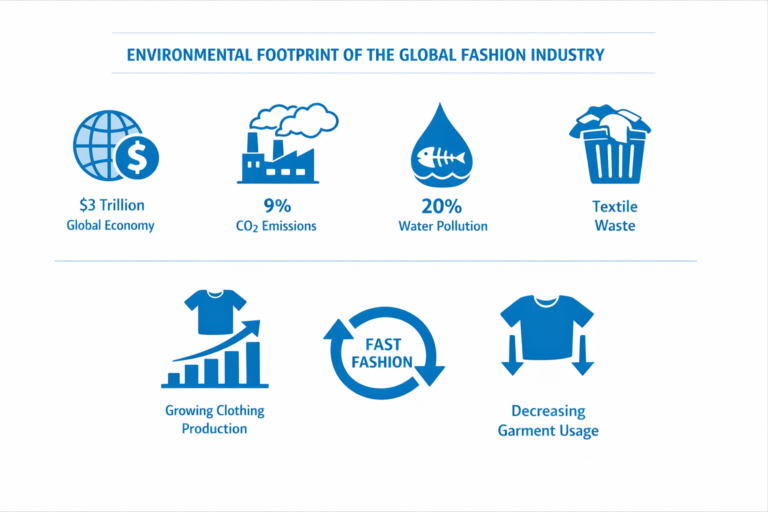
The fashion industry stands as one of the most influential economic sectors globally, generating approximately $3 trillion annually and contributing nearly 2% of global GDP. Yet, its environmental footprint is equally significant. The sector is estimated to account for 9% of global greenhouse gas emissions and nearly 20% of worldwide water pollution, largely due to energy-intensive manufacturing and chemical-heavy textile processing.
These impacts are further intensified by fast-fashion business models, which:
Accelerate production cycles
Shorten product lifespans
Increase textile waste
Complicate end-of-life management
Global clothing production has roughly doubled since 2000, while the average number of times a garment is worn has dropped by approximately 40%. Some ultra-fast fashion items are discarded after just 7–10 wears, reflecting a linear consumption pattern that amplifies resource depletion and waste generation.
Growing Regulatory and Market Pressure in Europe
The sustainability debate in fashion is no longer voluntary — it is regulatory, financial, and consumer-driven.
Nearly six in ten EU citizens report willingness to pay more for sustainably produced and repairable products. This shifting consumer mindset aligns with major policy reforms across the European Union.
Several key regulatory developments are reshaping accountability:
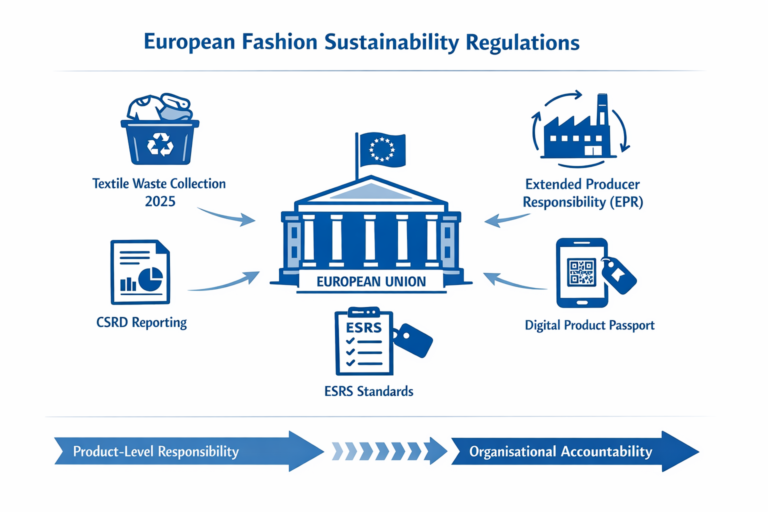
Separate collection of post-consumer textiles mandated from January 2025 under the amended Waste Framework Directive
Introduction of eco-modulated Extended Producer Responsibility (EPR) schemes for textiles
Phased sustainability reporting beginning 2025 under the Corporate Sustainability Reporting Directive
Mandatory compliance with European Sustainability Reporting Standards
Compulsory Digital Product Passports for textiles sold in the EU market
These measures signal a fundamental shift: environmental accountability is moving from individual products toward full organisational responsibility.
For fashion SMEs — particularly those embedded in subcontracting networks like Italy’s manufacturing ecosystem — this transformation presents both a challenge and an opportunity.
The Data Gap in Fashion Sustainability
Despite increasing commitments, organisations struggle with a persistent issue:
A lack of comprehensive, reliable data across their value chains.
This data scarcity limits informed decision-making and weakens credibility. A forensic review of voluntary climate targets revealed that by the end of 2024, only one-third of 2020 voluntary targets showed credible progress evidence.
Moreover:
Investors increasingly request cradle-to-gate environmental metrics
Global platforms demand quantifiable impact disclosures
Yet few life cycle studies in fashion adopt an Organizational LCA (O-LCA) perspective
Almost none focus on a real fashion SME
There remains limited empirical research demonstrating how environmental hotspots can be:
Identified
Quantified
Strategically acted upon
— particularly at the SME level.
Why Organizational LCA (O-LCA) Matters
To address this gap, this study applies Organizational Life Cycle Assessment (O-LCA), guided by:
ISO 14040
ISO 14044
ISO/TS 14072
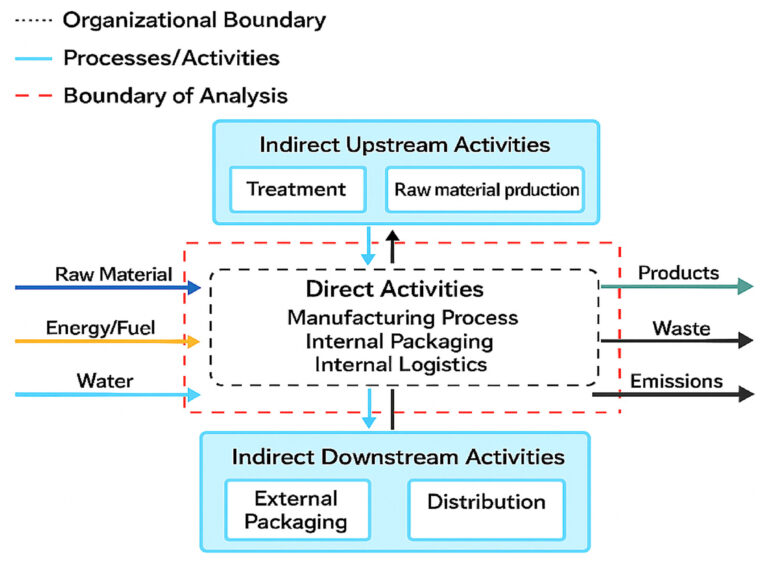
O-LCA extends traditional product-level LCA thinking to the entire organisation, analysing:
All inputs (materials, energy, water)
All outputs (products, emissions, waste)
Potential environmental impacts across the life cycle
Although O-LCA does not define a functional unit — limiting direct comparisons between different companies — it remains extremely valuable for:
Year-by-year internal benchmarking
Tracking environmental performance trends
Identifying strategic intervention points
This perspective is particularly relevant in Italy’s fashion ecosystem, which is dominated by networks of specialised subcontracting SMEs. In such systems, upstream and downstream impacts are often fragmented, making holistic assessment indispensable.
Study Objectives
Using SimaPro and the Ecoinvent database, this case study conducts an Organizational LCA of an Italian apparel SME with three primary objectives:
Identify the main activities driving environmental impacts within fashion SMEs
Demonstrate how O-LCA effectively quantifies and prioritizes hotspots
Show that adopting O-LCA delivers managerial and strategic value, not just reporting compliance
The study expands existing O-LCA research by:
Applying a hybrid inventory approach
Integrating activity-based reporting
Aligning with UNEP-SETAC Life Cycle Initiative guidance
Operating despite limited SME-level data availability
Most importantly, it translates environmental metrics into actionable business recommendations, including:
Transitioning to renewable electricity
Improving fibre sourcing strategies
Strengthening supplier engagement
Bridging Measurement and Strategy
This research responds to the urgent need for sector-specific, SME-centred evidence. By grounding methodological rigor in real operational constraints, it demonstrates that O-LCA is not merely a reporting tool — it is a strategic management instrument.
For fashion SMEs navigating regulatory pressure, investor scrutiny, and consumer expectations, Organizational LCA provides a structured pathway to:
Avoid burden shifting
Prioritize high-impact interventions
Align sustainability with competitiveness
In the next section, we will examine how the methodological framework was adapted to the realities of an Italian fashion SME and how system boundaries were defined for meaningful organisational assessment.
2. Methods
This study applies Organizational Life Cycle Assessment (O-LCA) as a structured methodology to quantify the environmental impacts of a fashion SME. O-LCA can be applied to any entity — companies, partnerships, or institutions — regardless of size or legal structure.
The methodological framework follows:
ISO 14040
ISO 14044
ISO/TS 14072
The approach mirrors traditional product LCA but expands the perspective to the entire organisation.
The Four Phases Applied
The study follows the classic LCA structure:
Goal and Scope Definition
Defines motivation, intended audience, system boundaries, and reporting flow.
Life Cycle Inventory (LCI)
Compiles all relevant inputs and outputs across direct, upstream, and downstream activities.
Life Cycle Impact Assessment (LCIA)
Translates inventory flows into environmental impact indicators.
Interpretation
Identifies hotspots, limitations, and strategic recommendations.
2.1 Goal and Scope Definition
Company Profile
The analysed company (name withheld for confidentiality) is:
Located in the Marche Region, Italy
2023 turnover: €5 million
Activity: Assembly and finishing of high-quality apparel (especially jeans) for major brands
Study reference year: 2023
Analysis period: February–September 2024
The firm specializes in:
Prototyping (on demand)
Manufacturing
Garment finishing
Quality control
It operates within Italy’s subcontracting-based fashion ecosystem.
Production Output (2023)
The total annual output amounted to:
62,463 pieces
27,458.34 kg of final products
The reporting flow — as recommended in O-LCA guidance — is based on total annual production weight (kg) rather than a functional unit.
Main Product Categories
Product Type | Quantity | Weight (kg) |
Men’s Pants | 14,636 | 8,049.80 |
Women’s Pants | 7,736 | 3,403.84 |
Children’s Pants | 16,551 | 3,310.20 |
Adult Jackets | 3,410 | 2,046.00 |
Boots | 5,450 | 5,450.00 |
Others (skirts, shirts, dresses, bags, belts) | — | Remaining share |
Total | 62,463 | 27,458.34 kg |
Production Process Overview
The organisational production flow includes:
Market research and material sampling
Prototyping and sample validation
Order confirmation and sourcing
Cutting, sewing, and assembly
Finishing and quality control
Packaging
Smaller batches are finished in-house, while larger volumes may be outsourced.
⚠️ Important: The system boundary includes direct production activities only, due to limited upstream and downstream data availability. This decision aligns with Clause 5.2.2 of ISO/TS 14072 and UNEP-SETAC guidance.
2.2 Life Cycle Inventory (LCI)
The Life Cycle Inventory phase compiles all material, energy, and emission flows within defined system boundaries.
According to ISO 14040 and ISO 14044, LCI involves:
Quantifying raw materials
Measuring energy consumption
Tracking water use
Accounting for emissions and waste
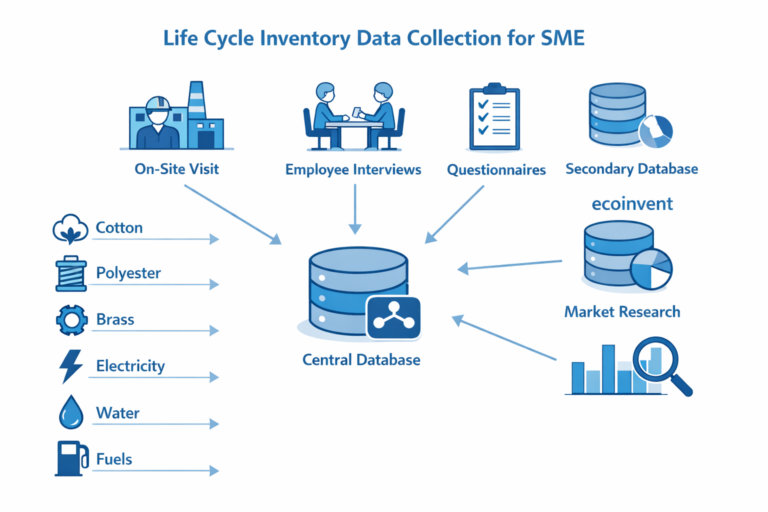
Data Collection Strategy
Due to low digitalisation and lack of historical environmental monitoring, the study relied primarily on secondary data.
Data Collection Activities
On-site visit
Employee interviews
Company-specific questionnaire
Market research and literature review
Mapping of organizational structure
Secondary datasets were sourced from:
Ecoinvent
This reliance on secondary data highlights a common SME challenge:
Environmental data is often fragmented, incomplete, or non-digitized.
Key Assumptions in Inventory Modelling
To address data gaps, several justified assumptions were made:
Fibre Composition
Only cotton and polyester considered dominant fibres
Elastane (0.07%) treated as negligible and classified under cotton
This simplification aligns with industry literature.
Accessories
Buckles, rivets, and buttons assumed to be primarily brass, due to lack of specification.
Such assumptions were necessary to maintain modelling completeness while acknowledging limitations.
Major Inputs Identified
Materials (Technosphere Inputs)
Cotton fibre (organic)
Polyester fibre
Brass
Packaging materials (carton board, corrugated board, kraft paper)
Polyester resin
Polyethylene granulates
Natural gas
Diesel
Deionised water
Electricity Consumption
238,206 kWh (low voltage, Italy)
This electricity input later emerged as a major environmental hotspot.
2.3 Life Cycle Impact Assessment (LCIA)
The Impact Assessment phase translates inventory flows into environmental impacts.
For this study:
Impact Method: ReCiPe 2016 Midpoint (H)
Database: Ecoinvent (allocation, cut-off system model)
Software: SimaPro version 9.1.1
Why ReCiPe 2016 Midpoint?
ReCiPe Midpoint was selected because:
It is widely used in apparel LCAs published after 2020
It improves comparability across studies
It avoids subjective weighting steps used in endpoint methods
It enables clear hotspot identification
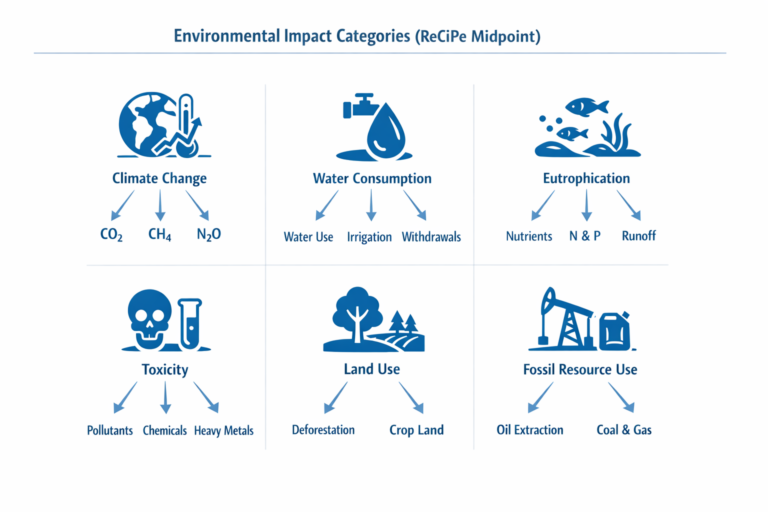
Impact Categories Assessed
The method evaluates 18 midpoint impact categories, including:
Climate change
Freshwater eutrophication
Water consumption
Fossil resource scarcity
Human toxicity
Terrestrial acidification
Midpoint indicators assess impacts at intermediate stages, allowing:
✔ Transparent environmental diagnosis
✔ Clear ranking of hotspots
✔ Reduced value-laden interpretation
Methodological Significance
This structured approach demonstrates that even with:
Limited primary data
SME-level constraints
Partial system boundaries
— O-LCA can still generate strategic, decision-relevant insights.
The methodology bridges:
Academic rigor
Real-world SME constraints
Regulatory alignment
Managerial applicability
In the next section, we will analyse the results and identify the environmental hotspots that drive the majority of the organisation’s impact — and how these findings translate into strategic action for fashion SMEs.
3. Results and Discussion
The Results and Discussion phase translates the Life Cycle Inventory (LCI) data into environmental meaning. Through the characterization process, material and energy flows are converted into potential environmental impacts. This allows the identification of environmental hotspots.
Subsequently, normalization compares these results to reference values, helping prioritise which impact categories are most significant relative to broader environmental burdens.
Together, characterization and normalization transform raw inventory data into actionable sustainability insights.
3.1 Characterization Results
Table 3 presents the environmental impacts per unit of final product.
Key Impact Results (per unit of product)
Impact Category | Value | Unit |
Global Warming | 8.46 | kg CO₂-eq |
Stratospheric Ozone Depletion | 5.06×10⁻⁵ | kg CFC11-eq |
Ionizing Radiation | 0.57 | kBq Co-60 eq |
Fine Particulate Matter | 0.01 | kg PM2.5 eq |
Freshwater Eutrophication | 0.02 | kg P eq |
Marine Eutrophication | 0.03 | kg N eq |
Terrestrial Ecotoxicity | 33.74 | kg 1,4-DCB |
Human Non-Carcinogenic Toxicity | 9.32 | kg 1,4-DCB |
Land Use | 18.09 | m² crop eq |
Fossil Resource Scarcity | 3.52 | kg oil eq |
Water Consumption | 0.20 | m³ |
Impact modelling was performed using ReCiPe 2016 Midpoint (H) within SimaPro, using Ecoinvent datasets.
Environmental Hotspot Analysis
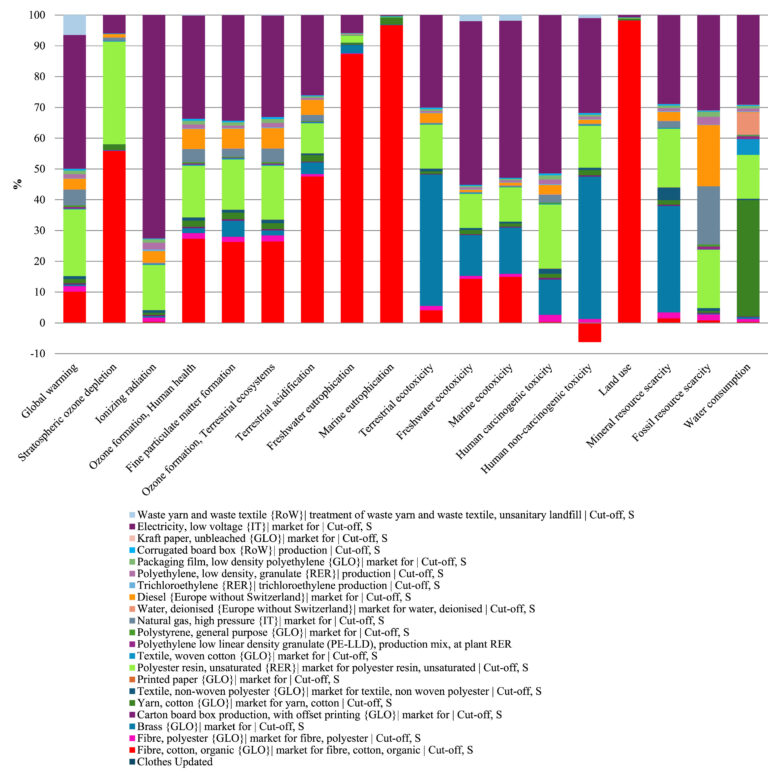
Global Warming Potential (GWP)
Baseline: 8.46 kg CO₂-eq per unit
Main contributors:
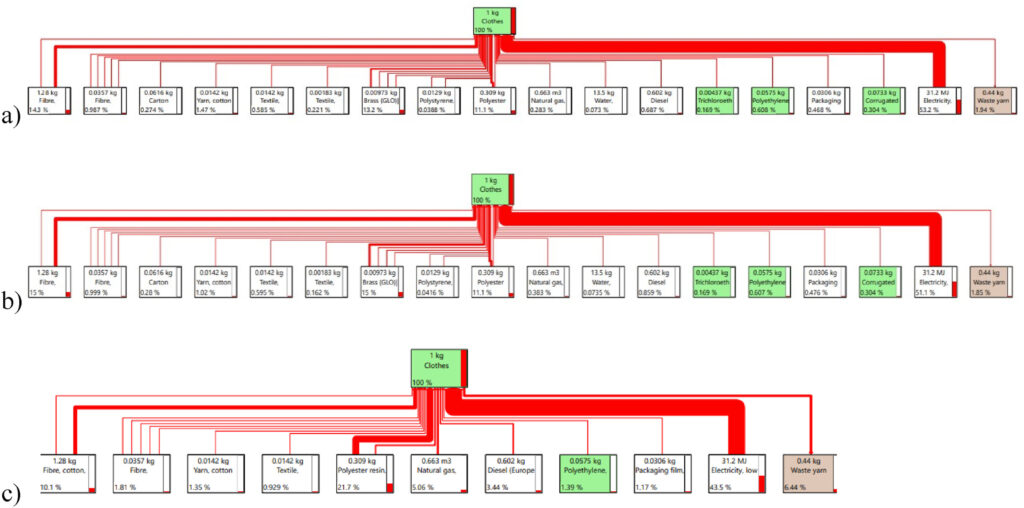
Electricity → 43.5%
Polyester resin
Cotton fibre
The polyester–electricity combination mirrors findings in recent apparel LCAs, where synthetic fibres and fossil-based electricity account for 55–70% of GWP in knitwear systems.
Why?
Polyester production is energy-intensive (PET spinning route).
Electricity mix still contains fossil fuels.
Cotton cultivation adds indirect emissions (fertilisers, field emissions).
Insight: Climate impact is both energy-driven and material-driven.
Freshwater Eutrophication
Dominated by:
Cotton fibre → 87.3%
Cause:
Nitrogen and phosphorus runoff from agriculture.
Fertilizer-intensive cultivation practices.
This confirms literature findings showing cotton agriculture as a major contributor to nutrient pollution, especially in regions with intensive monoculture.
Insight: Even “natural fibres” carry substantial upstream environmental burdens.
Water Consumption
Cotton fibre → 37.8%
Polyester resin → secondary contributor
Insight: Cotton’s irrigation requirements significantly drive water use impacts.
Toxicity Categories
Human Non-Carcinogenic Toxicity
Brass → 49.3%
Electricity
Polyester resin
Metal extraction and processing for accessories become visible only when aggregated at annual organisational scale — something product LCAs often underestimate.
Marine Ecotoxicity
Electricity → 51.1%
Brass → 15%
Polyester resin
Metal emissions and chemical discharges from synthetic fibre production drive these impacts.
Ozone Depletion
Main contributors:
Polyester → ~45%
Electricity → ~25%
Cotton yarn → ~10%
Virgin polyester production releases trace ozone-depleting substances during chemical processing.
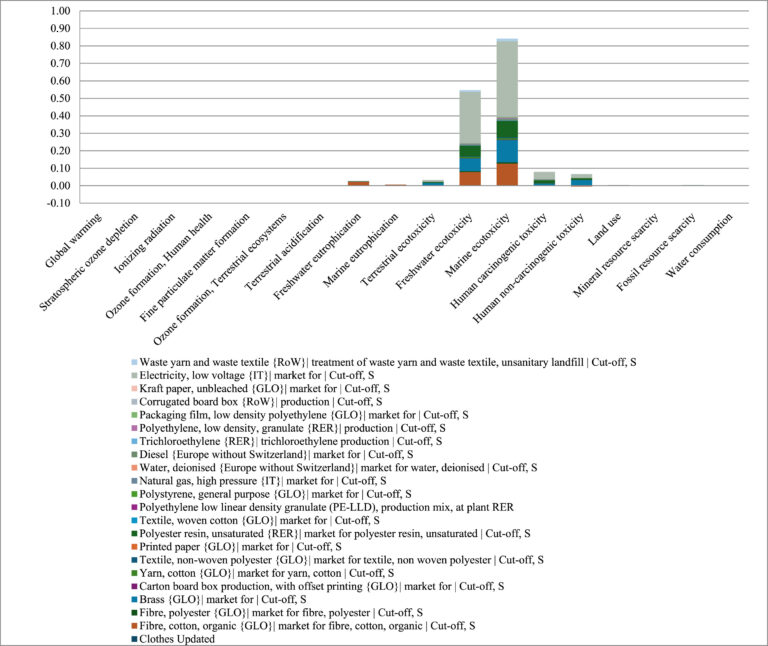
Normalization: What Truly Matters?
Normalization compares each category relative to a reference environmental burden.
Key insights:
Freshwater eutrophication stands out prominently.
Cotton dominates eutrophication.
Electricity remains central for climate and toxicity impacts.
Polyester influences ozone depletion and marine ecotoxicity.
This step confirms that:
Cotton and electricity are the primary organisational hotspots.
Strategic Interpretation of Results
Electricity: The Most Manageable Lever
Electricity contributes:
43.5% of GWP
51.4% of carcinogenic toxicity
53.2% of freshwater ecotoxicity
Because electricity procurement is operationally adjustable, it represents the short-term strategic lever.
If renewable electricity replaces the current mix:
GWP could drop by ~30% of electricity’s contribution.
Organisational climate footprint reduction ≈ 30–35%.
This aligns with apparel sector decarbonisation roadmaps.
Cotton: The Agricultural Challenge
Cotton drives:
87.3% freshwater eutrophication
37.8% water consumption
96.8% marine eutrophication (organic cotton context)
Mitigation pathways:
Supplier selection based on irrigation efficiency
Precision agriculture partnerships
Certified sustainable cotton (e.g., GOTS)
Increased recycled cotton use
Precision-irrigated cotton could reduce eutrophication loads by ~35%.
Polyester: Synthetic Fibre Trade-Off
Polyester contributes to:
Ozone depletion (33.4%)
Carcinogenic toxicity (20.8%)
Marine ecotoxicity (11.1%)
Switching to recycled polyester and improving recycling technologies could reduce impacts by ~35%.
Combined with renewable electricity:
➡ Potential total GWP reduction ≈ 34.6%
Sensitivity Analysis
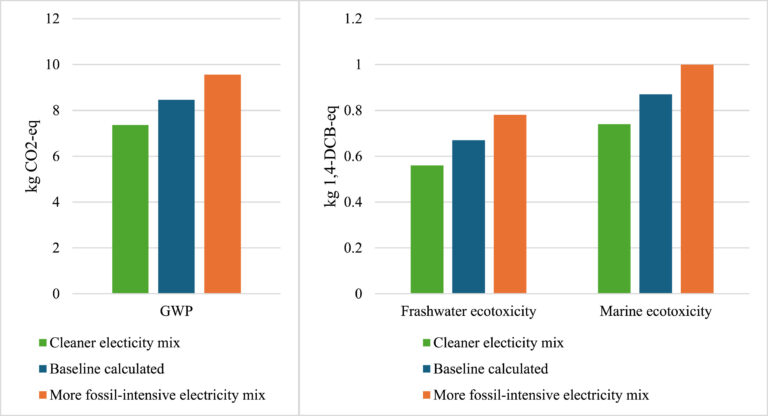
To test robustness, electricity impacts were varied ±30%.
Results:
Impact | Baseline | Cleaner Mix (-30%) | Fossil-Heavy Mix (+30%) |
GWP | 8.46 | 7.36 | 9.56 |
Freshwater Ecotoxicity | 0.67 | 0.56 | 0.78 |
Marine Ecotoxicity | 0.87 | 0.74 | 1.00 |
Findings:
Absolute values vary.
Hotspot ranking remains stable.
Electricity remains dominant driver.
This confirms methodological robustness despite reliance on secondary data.
3.2 Interpretation
The OLCA identified two main hotspots:
Electricity use
Cotton fibre sourcing
Recommended Actions
Transition to Renewable Energy
Solar installation or renewable procurement contracts
Expected GWP reduction: ~30% of electricity contribution
Sustainable Cotton Strategy
Partner with water-efficient suppliers
Adopt certified organic systems
Increase recycled cotton share
Polyester Improvements
Increase recycled content
Explore bio-based alternatives
Material Substitution
Replace brass with aluminium where feasible
Implement cleaner production technologies
Digitalisation as an Enabler
A major limitation was reliance on secondary data.
To improve:
IoT-enabled energy monitoring
Blockchain-based supplier tracking
Digital compliance integration for Corporate Sustainability Reporting Directive
Alignment with European Sustainability Reporting Standards
Digital tools would strengthen:
Data precision
Reporting reliability
Strategic monitoring
4. Conclusions
This study demonstrates that Organizational LCA is both feasible and strategically valuable for fashion SMEs, even under data constraints.
Key confirmations:
OLCA effectively identifies organisational hotspots
It supports managerial decision-making
It enhances regulatory preparedness
It builds internal sustainability capacity
Beyond environmental metrics, OLCA acted as a capacity-building mechanism, improving awareness and triggering internal strategic shifts:
Renewable electricity discussions initiated
First sustainability reporting efforts drafted
Commitment to repeat OLCA for year-on-year comparison
Broader Implication for Fashion SMEs
OLCA bridges:
Environmental science
Regulatory compliance
Strategic management
Operational decision-making
For Italian and European fashion SMEs navigating CSRD, ESRS, and digital passport requirements, OLCA represents:
A practical, scalable, and forward-looking sustainability instrument.
Future research should:
Expand to multi-year assessments
Increase primary data integration
Integrate OLCA outputs into digital product passports
Explore circular business model innovations
Final Reflection
This case confirms that sustainability in fashion is not only about greener fabrics — it is about organisational transformation through system-level understanding.
OLCA provides the structure to make that transformation measurable, strategic, and actionable.
Source: This analysis is based on the peer-reviewed article published in Research Gate, Organizational life cycle assessment: A case study in the fashion industry small and medium enterprises
Available at: https://www.sciencedirect.com/science/article/pii/S2666016425002208